
Consider STACK for
A shared takeoff and estimating workspace with cost libraries and proposals.Takeoff and estimating software comparison
RenderDraw vs. STACK
Compare estimate libraries, review history and the work required to move accepted quantities into your bid.
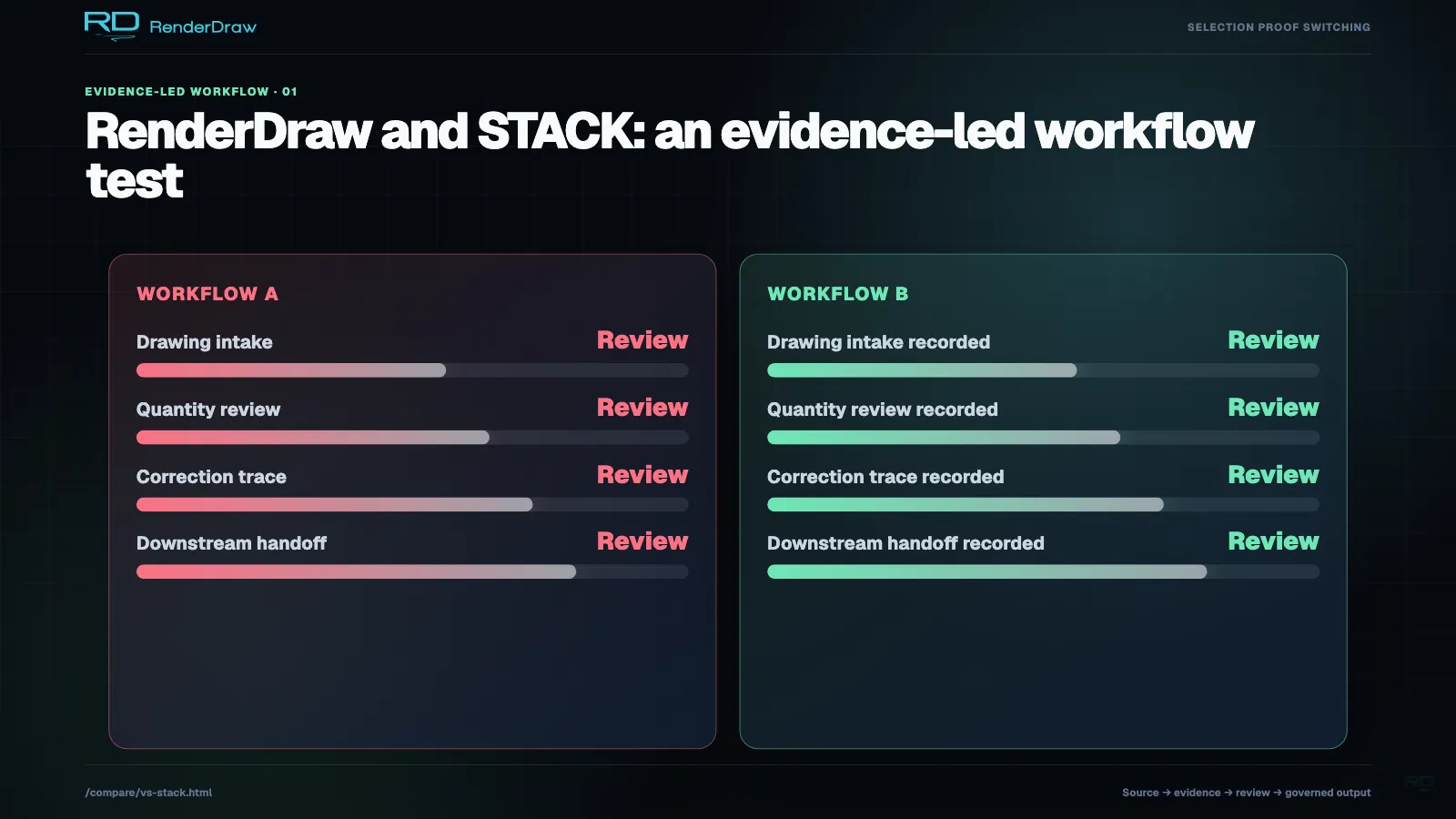
Same source packageRecorded review effortComparable output
The short answer
Include your existing cost library in the decision.
Consider STACK when you want cloud takeoff and native estimating with items, assemblies and proposal tools. STACK also documents measurement-level history. Include the cost of migrating your existing library before choosing an alternative. [2] [1]
Evaluate RenderDraw when you need a configured review process and a handoff into your quoting systems. Ask us to demonstrate the source, accepted quantity and price on one of your estimate rows. [5]
Evaluate RenderDraw for
Project-specific source review and configured handoff into the systems you use to quote.STACK capabilities
STACK includes estimating and review history.
Request the plan and AI add-ons you would purchase, then use them throughout the test.
Measurement history
STACK documents activity records at project, takeoff and individual measurement levels, including previous values. Test how a second estimator uses those records. [1]
Native estimating
You can work with items and assemblies, material and labor rates, estimate worksheets and proposal tools. [2]
STACK IQ
STACK announced an MCP connection for conversational work with Claude and ChatGPT, including library creation and estimate audits. These are vendor-described capabilities. [3]
Evaluate RenderDraw
Test the path into your commercial workflow.
We design RenderDraw to keep source evidence and estimator decisions attached to accepted quantities. The required connections depend on your configuration.
Explain a priced row
Ask us to show the source drawing, quantity decision and catalog or assembly mapping for one priced item. Check units and the price source. [5]
Resolve changed scope
Bring an addendum that changes an equipment type or finish. Ask us to show which accepted quantities need review before your team prices the revision. [6]
Check specialist references
For equipment or systems work, bring the supporting schedule or matrix. Confirm the relationship between the installed item and its requirements during review. [6]
Side-by-side comparison
RenderDraw vs. STACK
Compare documented vendor features with the RenderDraw workflow you need to demonstrate. Confirm availability and purchased modules with each vendor.
| Evaluation area | RenderDraw | STACK |
|---|---|---|
| Estimate preparation | Test configured catalog and assembly mapping. | Native items, assemblies, rates and worksheets. [2] |
| Review history | Inspect the quantity source and estimator decision in your demo. | Project, takeoff and measurement-level activity history. [1] |
| AI workflow | Evaluate defined identification and reconciliation tasks for your industry. | Trade AI tools and the announced STACK IQ connection. [1] [3] |
| Purchased scope | Confirm required review controls and destination integrations. | Confirm base plan, user add-ons and company add-ons. [4] |
Run this buyer test
Change an assembly after the first estimate.
Use an interior or HVAC scope with an existing cost library. This proposed exercise checks migration and review effort; we have not run it as a vendor benchmark.
Explore construction takeoff workflows-
Import a known assembly
Bring a wall assembly or equipment package you use today. Check component quantities, labor basis and purchase-unit rounding against your reference estimate.
-
Revise one requirement
Change a specified layer or accessory without changing the plan geometry. Inspect the affected component and price. Preserve the earlier estimate for comparison.
-
Hand it to a second estimator
Ask them to explain the change from source to estimate and produce the required output. Record missing history, manual updates and migration work.
Buyer checklist
Record the work needed to accept a takeoff.
- Confirm the controlling sheets, revision dates and scale against a known dimension.
- Record missed items and duplicate counts as separate errors. Check a sample of accepted items too.
- Have a second estimator trace a quantity to its drawing and explain the scope decision.
- Price the same package, including review labor, add-ons and integration setup. Record correction time.
Buyer questions
RenderDraw vs. STACK FAQ
Does STACK retain a takeoff audit trail?
STACK documents measurement-level activity history and prior values. Test the record you need for corrections and review. [1]
Can STACK connect to conversational AI?
STACK announced STACK IQ for connections to tools such as Claude and ChatGPT. Confirm the account setup and permissions for your use case. [3]
Should I replace an established STACK library?
Include migration in the pilot. Rebuild one real assembly and compare accepted quantities, rates and review effort before committing to a change.
Is RenderDraw a lower-cost STACK alternative?
We have no like-for-like cost study. Compare the exact seats, AI entitlements, integration work and estimator time for your workflow.
Sources and methodology
Read the product sources.
RenderDraw wrote this comparison and reviewed these sources on September 11, 2026. We describe vendor claims and propose buyer tests. We have not run a controlled head-to-head benchmark. Confirm features and terms in your quote.
- [1] STACK takeoff Measurement tools and activity history.
- [2] STACK estimating Libraries, rates, worksheets and proposals.
- [3] STACK IQ announcement September 1, 2026 announcement.
- [4] STACK licensing options Plans and add-on entitlements.
- [5] RenderDraw Takeoff workflows Our product description; confirm the configuration in your evaluation.
- [6] RenderDraw: takeoff identification and review across 20 industries Development focus and industry-specific evaluation tasks.
Evaluate on your documents
Bring one real drawing package.
Ask us to demonstrate quantity review and pricing with the files, scope and output your team needs.
Continue comparing