
Fire alarm estimating: devices, pathway, programming, test.
A fire alarm estimate covers initiating and notification devices, panels and power supplies, wire and pathway, programming, testing and closeout. Device counts are the easy part to see. The cost hides in pathway requirements, NAC power, interfaces with other systems and acceptance testing with the AHJ.
Send one plan set. See what the AI extracts and what it flags for review. No obligation.
- Device takeoff by type
- Wire and pathway
- Programming and testing
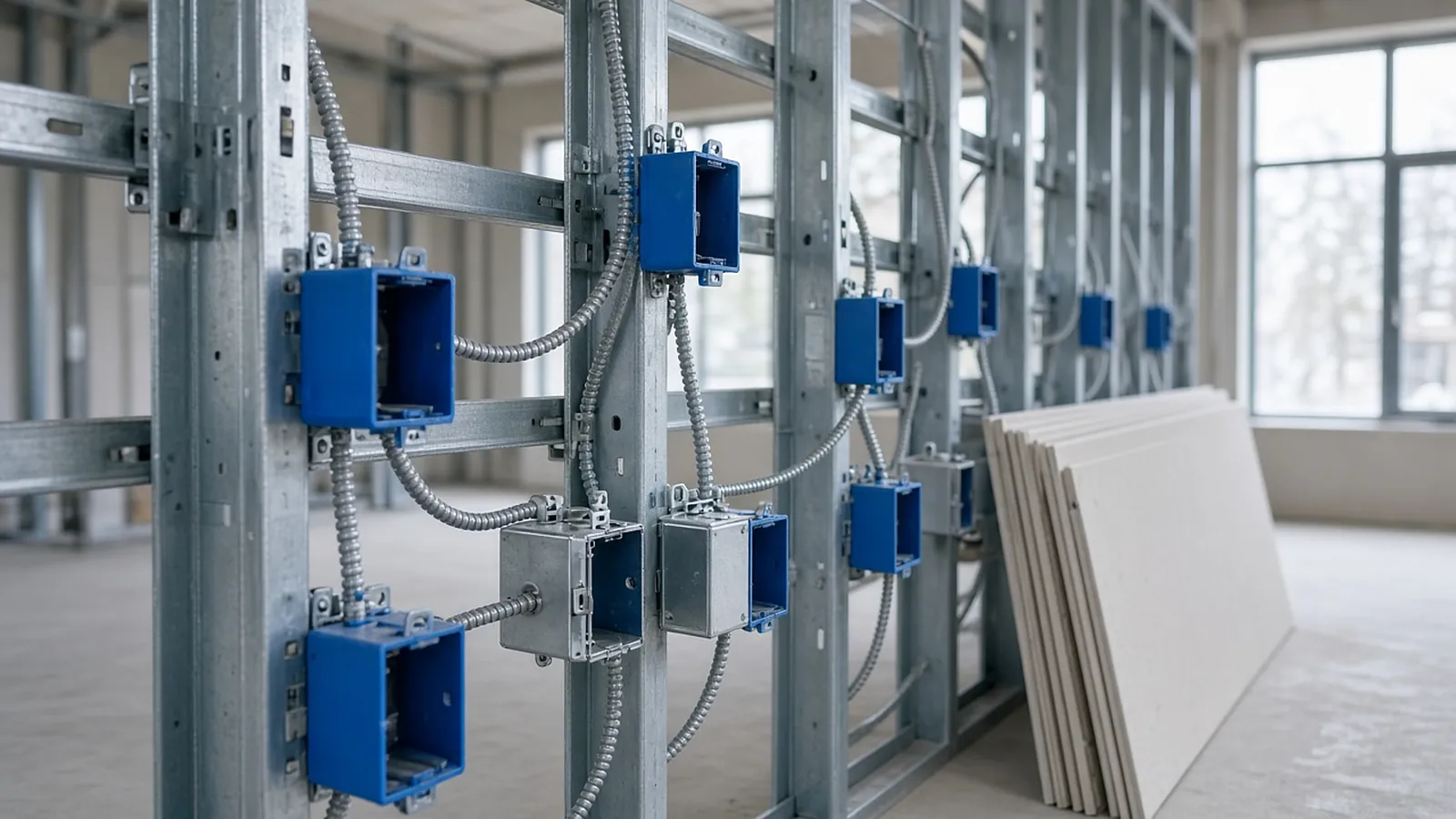
Scope first: who designs, who supplies, who programs
Read the fire alarm spec (usually 28 31 00 or 28 46 00, depending on the edition of MasterFormat the project uses) and the drawing notes before counting. The answers change the estimate more than any device count:
- Design-build or engineered design? On design-build work you're responsible for the layout, shop drawings, battery and voltage drop calculations and the permit submittal, usually prepared by a NICET-certified designer. On an engineered design you install to the drawings, but you still submit shop drawings.
- System type. Addressable or conventional, with or without emergency voice/alarm communications (EVACS). Voice systems add amplifiers, speakers and stricter pathway survivability.
- Supply model. Many electrical contractors buy the panel and devices from a fire alarm vendor who also provides programming, technician support and testing. Get that quote early and read its exclusions.
- Interfaces. Monitoring, elevator recall, HVAC shutdown, smoke control, door release, sprinkler supervision, kitchen hood suppression and generator status.
- Existing building? Tie-ins, phasing, temporary systems and fire watch during cutover.
Device takeoff by type and variant
Count devices from the FA plans by type, matching the legend (often based on NFPA 170 symbols). Keep model variants as separate line items:
- Initiating: manual pull stations, smoke detectors, heat detectors (fixed or rate-of-rise), duct detectors, beam detectors, aspirating systems.
- Notification: horns, strobes and horn/strobes by candela rating and wall or ceiling mount; speakers and speaker/strobes by tap setting; outdoor and weatherproof variants.
- Modules: monitor modules (waterflow and tamper switches, kitchen hood, generator) and control or relay modules (fans, dampers, door holders, elevator recall).
- Equipment: FACP, annunciators, NAC power extenders, amplifiers, batteries and cabinets, communicators, remote test switches for duct detectors.
Then go looking for devices on other disciplines' sheets: duct detectors and smoke dampers on mechanical sheets (often furnished by FA and installed by mechanical), flow and tamper switches on fire protection, door holders and access control release on hardware schedules, elevator interfaces on vertical transportation sheets.
Wire and pathway
Estimate circuits by type: signaling line circuits (SLC), notification appliance circuits (NAC), speaker circuits, 24 VDC power and network or riser cabling.
wire (ft) ≈ devices × average run per device × (1 + slack and waste)
             checked against plan distances, ceiling heights and riser lengths
labor hrs  = Σ devices × hrs/device + wire ft × hrs/ft + equipment and termination hrs
Pathway rules can swing labor more than device count:
- Conduit everywhere vs. cable in accessible ceilings. Read the spec and local amendments; some jurisdictions require raceway.
- Survivability. NFPA 72 requires higher pathway survivability for some voice systems. Level 2 generally means 2-hour fire-rated circuit integrity cable, a 2-hour rated cable system, or a 2-hour rated enclosure or protected area. Level 3 adds full sprinkler protection. Survivable cable costs far more per foot than standard fire alarm cable and is slower to install.
- Class A or Class X circuits need return paths, which roughly doubles some runs.
Power: NAC extenders and batteries
Notification load drives power supplies. Large strobe counts at high candela settings need more NAC power extenders, and each one needs a location, a 120V circuit and batteries.
NFPA 72 requires secondary power for a typical system to run 24 hours in standby followed by 5 minutes in alarm. For EVACS it's 24 hours standby followed by 15 minutes of alarm at maximum connected load. Battery calculations size the batteries. Make sure your bid says who prepares them, and price the batteries from the calculation rather than a guess.
Labor: install, program, test, retest
Device installation labor uses your labor units by device type and mounting condition (open ceiling, hard lid, high ceiling with a lift). Then add the items that are easy to underprice:
- Panel and power supply installation and terminations.
- Programming, often by the vendor. Get the hours in the quote.
- Pre-testing every device before the acceptance test.
- Acceptance testing with the AHJ, which can take several days with a technician and an electrician on each floor.
- Retest after AHJ comments. Assume at least one partial retest on complex jobs.
- Documentation: record drawings, record of completion, battery and voltage drop calculations, sequence of operations matrix.
Example: an interface count
A building with two elevators, four air handlers and a sprinkler riser per floor on three floors might need:
| Interface | Devices | Count |
|---|---|---|
| Elevator recall (primary, alternate, hoistway/machine room) | Control relays per elevator group, plus detectors | 2 groups |
| Shunt trip where sprinklered machine rooms require it | Control relay, heat detector | 2 |
| AHU shutdown | Duct detector + relay per unit | 4 + 4 |
| Waterflow and tamper | Monitor modules per riser per floor | 3 flow + 3 tamper |
| Door holders | Relays per zone | from hardware schedule |
| Remote test stations for duct detectors | Per detector where required | 4 |
Illustrative. Count each interface from the sequence of operations matrix and riser, not from memory, and confirm who provides the device on the other side of each interface.
Scope checklist
- Shop drawings, calculations and permit submittal: included?
- Monitoring service and communicator lines: who provides?
- Elevator recall, HVAC and smoke control: wiring to equipment, and who makes the final connection?
- Two-way radio enhancement (ERCES/BDA) if the fire code requires it: in your scope or separate?
- Existing system tie-ins, phasing in occupied buildings, fire watch during cutover.
- Spare devices, tools and owner training required by the spec.
Common fire alarm estimating mistakes
- Counting notification devices without checking candela or speaker tap settings, which change the model and the power load.
- Missing monitor and control modules for every switch, damper, fan and door interface.
- Underestimating NAC power extenders and batteries on large notification layouts.
- Pricing standard cable where survivable cable or 2-hour pathway is required.
- Pricing installation but not pre-test, acceptance test and retest.
- Assuming cable in accessible ceilings where the spec or local amendments require conduit.
Fire alarm estimator career notes
Fire alarm estimators often come from installation, design or technician roles. NICET certification in Fire Alarm Systems (Levels I to IV) is common in the field and is often required for designers. Some jurisdictions require NICET certification for plan submittals. Pay varies by region and employer.
Where RenderDraw fits
RenderDraw's AI takeoff proposes fire alarm device counts by type against the sheet legend, links every count to its sheet and location, and puts uncertain symbols in a review queue. You still decide the variants, pathway, power and testing assumptions.
Where RenderDraw fits: the counting, with your review.
Speed is easy to promise. Defensible numbers are the job, so RenderDraw keeps the estimator in control of every quantity that gets priced.
- Source on every row. Each quantity keeps its source sheet, location and reviewer decision.
- Lowest confidence first. The review queue shows the drawing tile with the detection highlighted and the extracted value.
- Uncertain items flagged, not hidden. Anything the AI can't confirm goes to the estimator rather than being guessed.
- Nothing priced before approval. Rows move on to pricing only after they are accepted.
Questions estimators ask
How do you estimate a fire alarm system?
Define the scope and who supplies what, count devices by type and model variant from the FA plans and other trades' sheets, add panels, power extenders and batteries, estimate wire and pathway by circuit type, then labor for installation, terminations, programming, pre-test, acceptance test, retest and closeout.
How is fire alarm wire estimated?
Usually by circuit type (SLC, NAC, speaker, power). A common approach is device count times an average run per device for each circuit type, checked against plan distances and riser heights, plus slack and waste. Survivability requirements can change the cable type and pathway.
How long must fire alarm batteries last?
Under NFPA 72, secondary power for a typical system must run 24 hours in standby followed by 5 minutes in alarm. For in-building emergency voice/alarm communication systems it's 24 hours standby followed by 15 minutes of alarm at maximum load. Battery calculations size the batteries; confirm who prepares them.
What does a fire alarm estimation engineer do?
Prepares the takeoff and pricing for fire alarm systems, often reviewing device layout, battery and voltage drop calculations and code requirements. Many hold NICET certification in fire alarm systems.
What is commonly missed in fire alarm bids?
Monitor and control modules for every interface, devices on mechanical and fire protection sheets, NAC power extenders, survivable cable or 2-hour pathway for voice systems, acceptance test retests, and existing-system tie-ins with fire watch.
Can AI count fire alarm devices?
Yes, with review. RenderDraw proposes device counts by type against the legend, with every count linked to its sheet and location, and sends uncertain symbols to the estimator.
See what the AI reads on your own drawings.
Send one representative electrical plan set. RenderDraw reviews it and follows up with what the AI extracted and what it flagged for review. Your files remain private while the request is assessed, and there is no obligation.
- Upload power and lighting plans, the fixture schedule, panel schedules, the one-line and the Division 26 spec sections.
- RenderDraw reviews the set and the scope you want tested.
- We follow up with extracted quantities, flagged items and next steps.
Related tools and guides
Keep reading on renderdraw.com
Sources and further reading
- NFPA 72: National Fire Alarm and Signaling Code (2025 edition)
- NFPA: Guide to Fire Alarm Basics, Power Supplies
- NFPA Research Foundation: Data and voice signals in pathway survivable cables
- NICET: Fire Alarm Systems certification
- NFPA 170: Standard for Fire Safety and Emergency Symbols
Figures marked as rules of thumb are starting points, not standards. Check the current edition of any code or standard your project specifies, and use your own historical production rates where you have them. Sources checked 2026-11-01.