
Steel erection estimating: pieces, picks and cost per ton
Erectors compare bids in dollars per ton, but cranes and raising gangs work in pieces. Two 180-ton jobs can need very different crane time. This guide builds an erection estimate from piece count, picks per day, connection type and site conditions, then uses cost per ton only as a check.
- Piece count drives hours
- Picks per crane-day
- Bolting and field welding
- Cost per ton as a check
Why cost per ton misleads
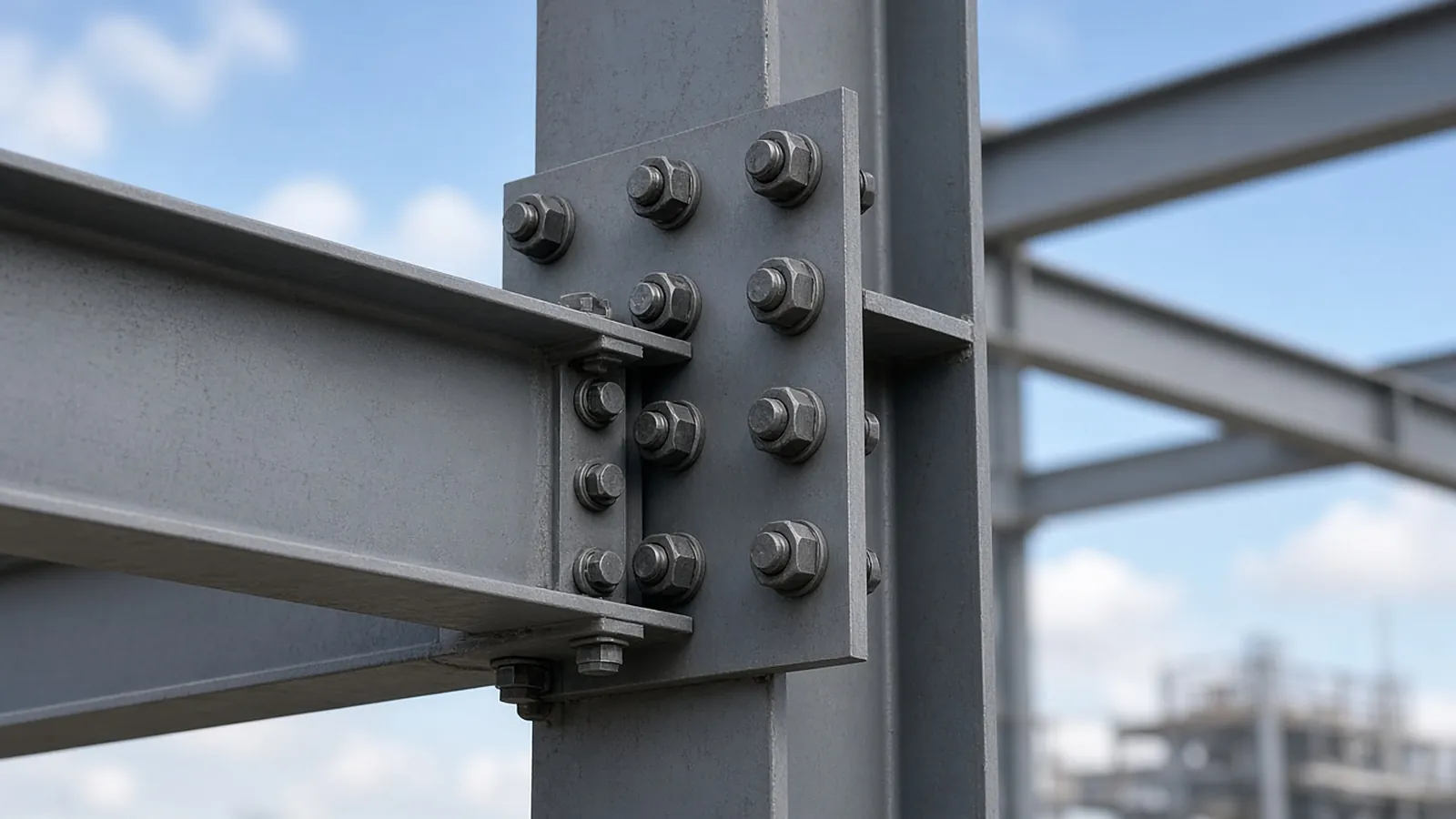
Cost per ton is useful for comparing bids and checking a finished estimate. It's a poor way to build one, because field work doesn't scale with weight. A crane cycle is hook on, lift, swing, land, hang at least two bolts per end (the OSHA minimum before the hook is released), unhook and swing back. That cycle takes about the same time whether the piece is a W12x26 or a W21x62.
Illustrative comparison:
| Office building | Industrial building | |
|---|---|---|
| Tons | 180 | 180 |
| Pieces | 1,150 | 450 |
| Average weight per piece | 313 lb | 800 lb |
| Picks per crane-day (assumed) | 24 | 24 |
| Crane days | 48 | 19 |
Same tonnage, about 2.5 times the crane time. If both jobs were priced at the same dollars per ton, one of them was priced wrong.
Build the erection takeoff from the member list
Use the same member list as the fabrication estimate so the two never drift apart, but group it by what drives field work:
- Columns by tier, with splices, base plates, leveling plates or nuts, and grouting (check whether grout is in your scope or the concrete contractor's).
- Beams and girders by floor and weight class. Light infill beams can sometimes be rigged in multiples (Christmas-treeing), which OSHA 1926.753 allows only under specific conditions.
- Bracing and moment frames. More field time per piece, more bolts, often field welds.
- Joists and joist girders by count, with bridging. OSHA 1926.757 has specific erection bridging and attachment requirements for joists that affect sequence and labor.
- Deck by square foot, with the fastening pattern (puddle welds or powder-actuated fasteners, plus side-lap fasteners) from the deck schedule.
- Misc. steel by the erector: lintels, edge angles, roof frames, screen walls, stairs and rails if they're in scope.
- Connections: field bolts by installation type and field welds by length and position.
Picks and crane days
Crane productivity sets the pace of most erection jobs. Calculate it separately from labor:
crane days = picks ÷ picks per crane-day
labor days = field man-hours ÷ (crew size × hours per day)
Your last few comparable jobs are the best source for picks per day. Published planning figures for conventional low-rise framing with good access are mostly in the 15 to 25 range per crane per day. Treat that as a rule of thumb. Adjust down for:
- Height and long hook cycles.
- Tight sites without laydown, where steel has to be shaken out in sequence or delivered just in time.
- Heavy members needing tandem picks or special rigging.
- Field-welded moment connections that hold the crane while connectors fit up.
- Sequencing with other trades (deck pours, precast, elevator rails).
- Wind and cold-weather days. Crane days are calendar days.
Then size the crane for the heaviest pick at the longest radius, not the average one, and carry mobilization, assembly and dismantling as separate lines. A raising gang (typically a foreman, two hooking on and two connectors) is sized to one crane. Adding ironworkers doesn't speed up the crane; it creates a second gang that needs a second crane.
Bolting and welding: connection type sets the labor
The RCSC Specification for Structural Joints defines three installation types, and they price very differently:
| Joint type | Field work | Estimating note |
|---|---|---|
| Snug-tight | Bolts brought to snug-tight | Fastest; most shear connections in buildings |
| Pretensioned | Snug, then pretension by turn-of-nut, calibrated wrench, twist-off (TC) bolts or DTIs | More time per bolt and pre-installation verification |
| Slip-critical | Pretensioned plus specified faying surface condition | Surface prep, coating control and inspection |
Read the structural general notes and the steel spec for which joints are pretensioned or slip-critical. Bracing, moment connections and anything with cyclic loading often are. Also check special inspection requirements, since you'll support the inspector's access and schedule.
For field welds, count by length, size and position. Overhead and vertical welds are slower than flat, and moment connections often need backing bars, weld access holes and ultrasonic testing.
OSHA Subpart R items that show up in the price
Subpart R (29 CFR 1926.750 to 1926.761) is the federal steel erection standard. A few provisions directly affect cost:
- Column anchorage (1926.755): at least four anchor rods per column. Coordinate anchor rod surveys and repairs before you mobilize; AISC 303 also addresses who is responsible for anchor rod placement and repairs.
- Connections (1926.756): at least two bolts per connection, wrench-tight, before the hoisting line is released. Double connections at columns need specific provisions.
- Fall protection (1926.760): connectors working above two stories or 30 feet, whichever is less, need fall protection. Between 15 and 30 feet there are specific connector rules. Perimeter cable is part of many erectors' scope; check the contract.
- Joists (1926.757) and decking (1926.754) have their own requirements for bridging, attachment and decking controlled-decking zones.
State plans (for example Cal/OSHA) can be stricter, so price to the jurisdiction.
Worked outline: putting the number together
An illustrative build-up for the 180-ton office building above:
Pieces                     1,150
Picks/crane-day (history)  24      → 48 crane days
Crane                      48 days × crane day rate + mob/demob
Raising gang               5 × 10 hr × 48 days = 2,400 MH
Bolt-up and plumb crew     from bolt count × MH per bolt by joint type
Deck                       sq ft × MH per square + fastener pattern
Misc. and stairs           by piece
Safety and perimeter cable lump sum per floor
Supervision and surveys    duration-based
Total ÷ 180 tons           → compare to similar past jobs
If the per-ton result lands well outside your history for this building type, look for a missed mobilization, the wrong picks-per-day rate, or a piece count that double-counts loose material.
Common holes in erection bids
- Crane cost buried inside an hourly composite rate, so nobody sees it's short.
- One crane priced when the schedule needs two gangs.
- Small picks ignored: stairs, rails, roof frames and screens all cost a crane cycle.
- Grouting, anchor rod repairs or perimeter cable assumed to be by others without saying so in the proposal.
- No allowance for weather days or other trades' delays.
Where RenderDraw fits
The erection estimate starts with an accurate piece list by type. RenderDraw's AI takeoff proposes member counts and lengths from framing plans and schedules, with the source sheet on every row, so fabrication and erection can work from the same list. Picks per day, crane selection and labor rates remain your call.
Member counts off the drawings, with the sheet attached.
RenderDraw's AI takeoff proposes steel member counts and lengths from plans, framing plans and schedules, links every row to its source, and sends low-confidence items to your estimator before the handoff to pricing.
- Counts and lengths by member. Proposed from the drawings and kept tied to the framing plan or schedule they came from.
- Uncertain items flagged. Items the AI can't confirm go to review instead of being guessed.
- Addenda through the same review. Send the changed sheets through takeoff and review, then reprice the members that changed.
- Your estimator decides. Connections, erection, coatings, risk and margin stay your call.
Test it on a real steel package
Send one structural set, ideally with an addendum. Sample files stay private while RenderDraw assesses the request. No obligation.
RenderDraw does not publish accuracy percentages or time-saved claims. Test it on your own plan set.
Questions estimators ask.
How is steel erection priced?
It is usually quoted lump sum and compared per ton, but it should be built from pieces. Count picks, divide by a picks-per-crane-day rate from your history to get crane days, price the raising gang and bolt-up crews separately, then add equipment, mobilization, safety and supervision. Divide by tons at the end as a check.
Why does piece count matter more than tonnage?
A crane cycle (hook on, lift, swing, land, two bolts per end, unhook) takes about the same time for a light beam as a heavy one. Twice the pieces per ton means roughly twice the picks and connections per ton.
How many picks per day can a crane make on steel erection?
It depends on the job, and your own records are the best number. Published planning figures for conventional low-rise framing with good access cluster around 15 to 25 picks per crane per day, lower for tall, congested, heavy or field-welded work. Treat any published figure as a rule of thumb.
What affects field bolting time?
Bolt count and installation type under the RCSC Specification. Snug-tight joints are fastest. Pretensioned and slip-critical joints need a pretensioning method (turn-of-nut, calibrated wrench, twist-off bolts or DTIs), and slip-critical joints also need prepared faying surfaces. Inspection requirements add time.
What OSHA rules affect an erection estimate?
OSHA 29 CFR 1926 Subpart R. Examples include at least four anchor rods per column, at least two bolts per connection before the crane releases a member, fall protection for connectors above two stories or 30 feet, and erection bridging rules for joists.
Can RenderDraw count pieces for erection?
RenderDraw's AI takeoff proposes members by type and count from the drawings with source sheets, the piece list an erection estimate starts from. Picks, crane choice and labor rates stay with you. Request a free sample takeoff.
Piece counts, straight from the framing plans.
Send a steel package. RenderDraw proposes members by type and count with their sheets, which is the piece count an erection estimate needs.
- Upload the plans, specs and schedules, plus an addendum if you have one.
- RenderDraw reviews the set and the scope you want tested.
- We follow up with extracted quantities, flagged items and next steps.
Related tools and guides
Sources and further reading
- OSHA 29 CFR 1926 Subpart R: Steel Erection (eCFR)
- OSHA 1926.755: Column anchorage
- OSHA eTools: Steel Erection, Fall Protection
- AISC 303: Code of Standard Practice for Steel Buildings and Bridges
- Research Council on Structural Connections (RCSC): Specification for Structural Joints
- Steel Estimator Pro: Price the crane by picks, not tons (published pick-rate ranges)
Figures marked as rules of thumb are starting points, not standards. Check the current edition of any code or standard your project specifies, and use your own historical production rates where you have them. Sources checked 2026-11-01.