
Fabricators win on pieces and connections, not just tons.
"Steel fabrication software" covers five different jobs: estimating the bid, detailing the shop drawings, managing purchasing and production, driving CNC machines, and tracking the work. Fabricators win on pieces and connections, not just tons, so the bid stage is where the right quantities matter most.
- Five jobs, five kinds of tool
- Pieces and connections
- Data handoffs
- Where RenderDraw fits
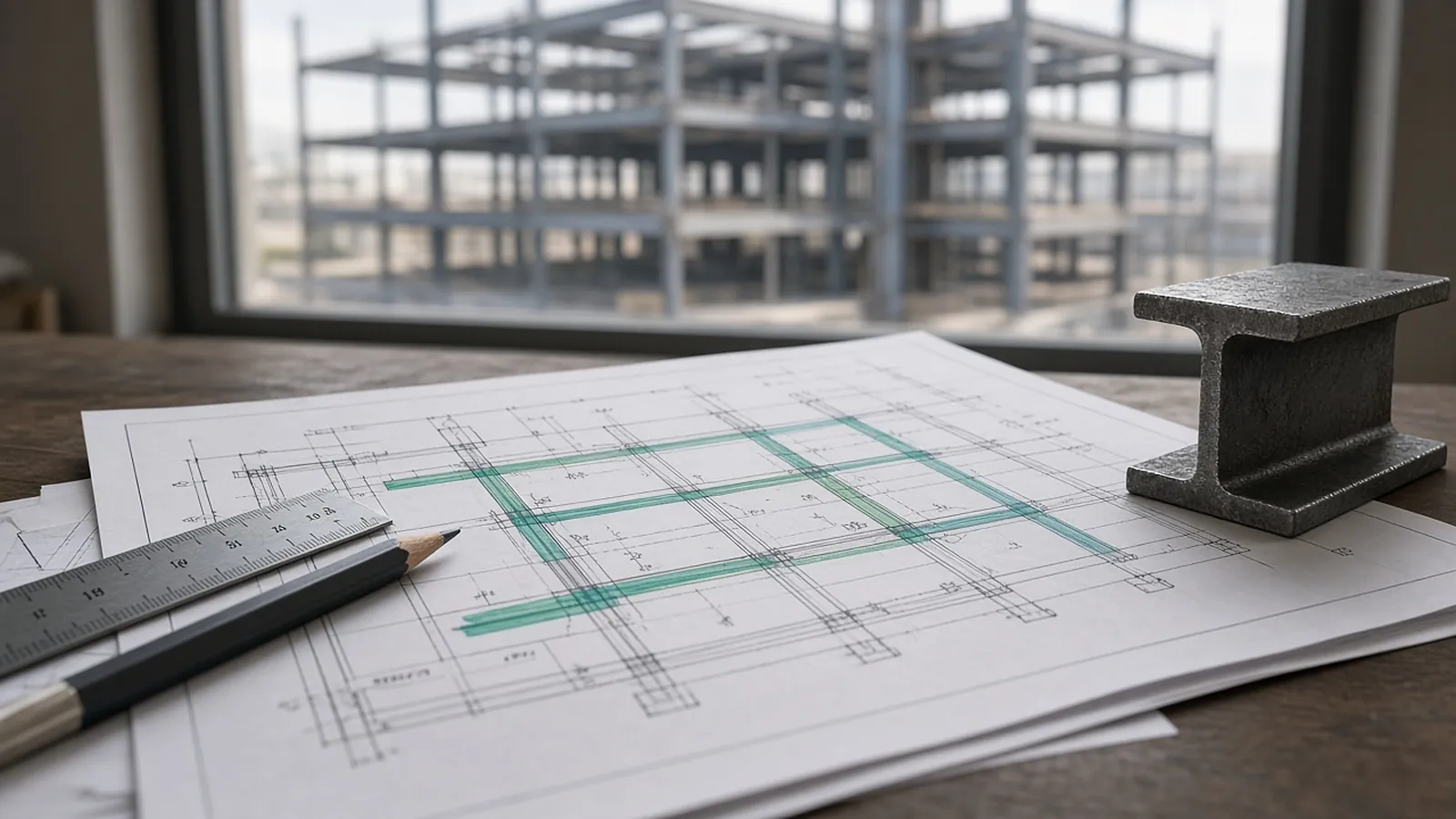
Which tool does which job
| Stage | What the software does | Common examples | Main input |
|---|---|---|---|
| Takeoff | Members, sizes, lengths, counts from bid drawings | Bluebeam, PlanSwift, SketchDeck.AI, SteelFlo, RenderDraw | PDF drawing set |
| Estimating | Prices the takeoff with material, labor standards, coatings, freight, erection | Tekla PowerFab, STRUMIS, spreadsheets | Bill of materials |
| Detailing | 3D model, shop and erection drawings, CNC files | Tekla Structures, SDS2, Advance Steel | Approved design, RFIs |
| Fabrication management (MRP/ERP) | Purchasing, inventory, nesting, production tracking, shipping | Tekla PowerFab, STRUMIS | Detailing model or BOM |
| Shop machines | Saws, drill lines, plasma and beam coping | Machine control software | DSTV/NC1 files from detailing |
Most shops run two or three of these, and the handoffs are where data gets retyped. A takeoff that exports in the format your estimating system imports saves the first retype.
What gets taken off
- Members. Size, length and count by mark, from framing plans and schedules.
- Connections. Beam ends by framing condition: shear tabs, clip angles, end plates, moment connections, base plates. Two jobs with the same tonnage can price very differently because connections, not tons, drive shop hours.
- Misc. metals. Lintels, embeds, rails, ladders, stairs and supports, often on architectural and MEP sheets.
- Weights. Length × lb/ft by shape from the AISC Manual, rolled up to tons. Pay weights under the AISC Code of Standard Practice use 490 lb/ft³ and don't deduct holes, copes or cuts.
- Finishes and special requirements. Galvanizing, AESS category, seismic demand-critical welds.
Labor standards, not tons
Fabrication estimating systems apply labor standards to each piece and operation: cut, drill or punch, cope, fit, weld, clean, paint, handle. That's why a takeoff that only gives tonnage forces the estimator back into the drawings to count connections. AISC's estimating teaching material lists the fabricator's cost components: material, shop labor by operation, detailing, coatings, freight, erection (if included), and overhead and profit.
Job A: 310 pieces, mostly W24–W36 girders, simple shear tabs
Job B: 1,180 pieces, W8–W16 infill, HSS braces, skewed connections
Shop hours follow pieces and connections → Job B will need
far more shop hours than Job A at the same tonnage
Questions to ask any vendor
- Which stage does it cover, and what does it hand off to the next stage?
- Does it read 2D PDFs, models, or both? Most bids still arrive as PDFs.
- Does the takeoff export in your estimating system's import format?
- Can it show what changed between two drawing revisions?
- Who owns the data, and can you export everything if you leave?
- Desktop or browser? Windows only? Bluebeam Revu's desktop app, for example, runs on Windows.
Run one bid side by side.
Pick a real job
Choose a recent bid with the plan set, legend, schedules and at least one addendum.
Build a baseline
Have an estimator check the quantities you want to test.
Run it side by side
Run the same set through your current tool and through a RenderDraw sample.
Score misses and review time
Record missed items, wrong inclusions and the time spent correcting each result.
Your sample files remain private while we assess the request. There is no obligation to proceed.
Questions estimators ask.
What is steel fabrication software?
Software that covers some part of a fabricator's work: takeoff and estimating for bids, detailing for shop drawings, fabrication management for purchasing and production, and machine control for CNC equipment. Most shops use more than one.
What is the difference between steel detailing and estimating software?
Estimating software prices the job at bid stage from the design drawings. Detailing software (such as Tekla Structures or SDS2) produces shop and erection drawings and CNC files after award.
What is Tekla PowerFab?
Trimble's steel fabrication management suite. It grew out of FabSuite, which Trimble acquired in 2018, and covers estimating, purchasing, inventory and production tracking.
Why count connections in a steel estimate?
Shop labor is driven by pieces and operations such as cutting, drilling, coping and welding, which follow connections. Two jobs with the same tonnage can need very different shop hours.
Does RenderDraw do detailing or nesting?
No. RenderDraw focuses on bid-stage quantities, estimator review and the handoff to pricing and quoting. Get a free sample takeoff.
Send one plan set. Judge the result yourself.
A focused, no-obligation evaluation on your own drawings. Your sample files remain private while we assess the request.
- Upload one representative plan set (a legible PDF set is the most reliable starting point), plus an addendum if you have one.
- RenderDraw reviews the set and the scope you want tested.
- We follow up with what was extracted, what was flagged for review, and the most useful next step.
Where these numbers come from
We checked this guide against the standards, manufacturer documents and industry references below (last reviewed November 2026). Figures marked as rules of thumb are typical ranges, not requirements; your project documents, local code and your own cost history govern.
- AISC Scheduling and Estimating teaching module — fabricator and erector cost components
- Trimble: Tekla PowerFab
- Trimble acquires FabSuite (2018)
- STRUMIS Estimating
- ANSI/AISC 303-22 Code of Standard Practice — §9.2 calculation of pay weights