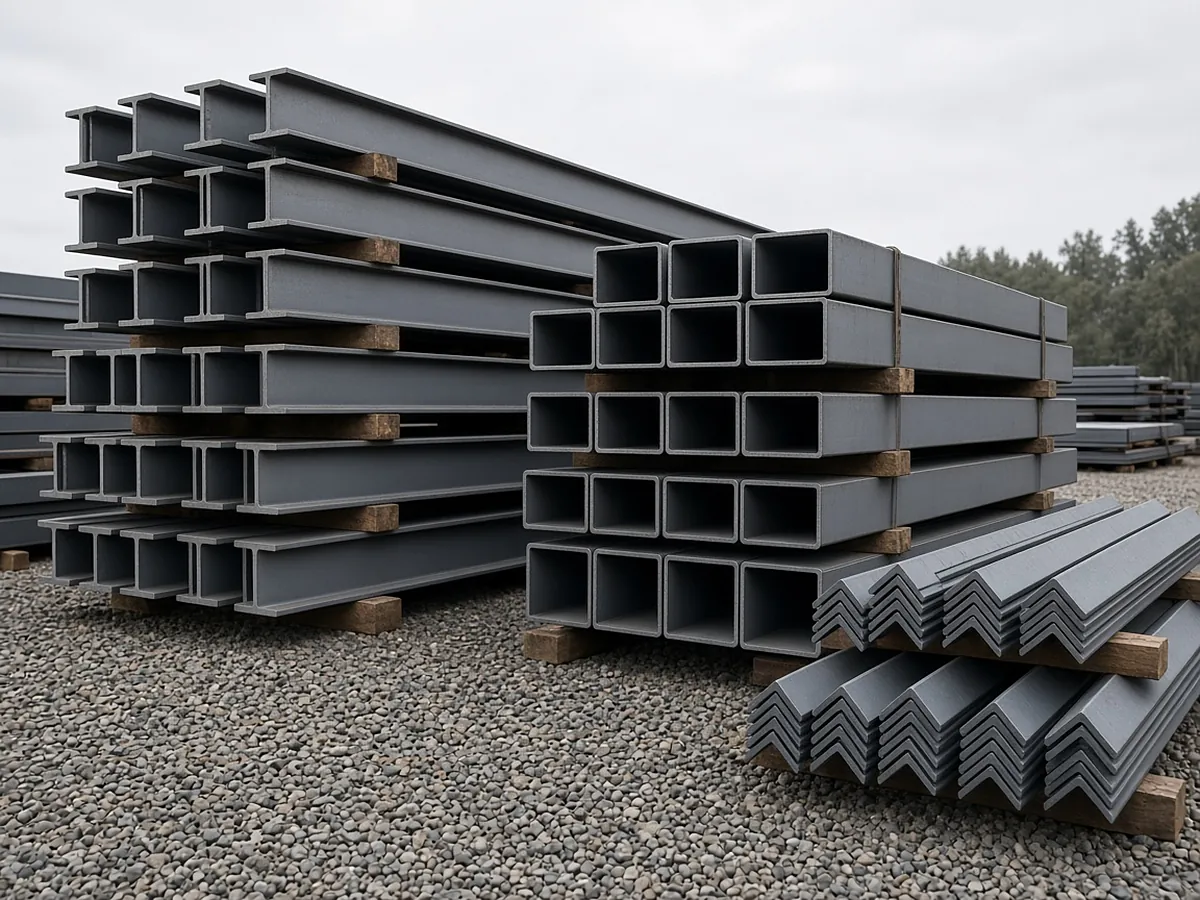
Where steel waste comes from
- Drops: what is left when members are cut from stock lengths. Depends entirely on how member lengths fit the lengths you buy.
- Plate nesting: unused plate around and between parts cut from a sheet or plate.
- Kerf and trim: material lost to the saw or torch and to squaring ends.
- Handling and errors: damage, mis-cuts and recuts.
Know the lengths you can buy
Mill and service-center purchasing are different problems. Nucor-Yamato's published wide-flange price list, for example, lists standard lengths of 30, 35, 40, 45, 50, 55 and 60 ft for standard sections (with longer lengths up to 80 ft for some sections), sold in bundle quantities without guaranteed piece counts. Non-standard lengths are available in 4-in. increments, subject to length extras and minimums, and all lengths carry a −0/+4 in. cutting tolerance. Service centers typically stock fewer lengths and offer cut-to-length for a fee. That gives you three strategies:
| Strategy | Waste | Tradeoff |
|---|---|---|
| Standard stock lengths, cut in shop | Depends on length fit | Lowest unit price; drops to manage |
| Mill order in exact or multiple lengths | Near zero beyond tolerance | Minimums, length extras, mill lead time |
| Service center cut-to-length | Near zero for you | Higher price per pound plus cutting charges |
AISC's estimating teaching module (1999) noted service-center steel could cost 30 to 50% more than mill steel. The spread changes with the market, but the decision is the same: waste on cheap stock versus a premium for exact lengths.
Drops are predictable
| Member length | Stock | Cuts per stock | Drop |
|---|---|---|---|
| 27 ft | 40 ft | 1 | 13 ft |
| 27 ft | 55 ft | 2 | 1 ft |
| 19 ft | 40 ft | 2 | 2 ft |
| 32 ft | 35 ft | 1 | 3 ft |
Illustrative; ignores kerf and end trim.
Ten W12x26 beams at 23 ft 4 in.
The waste factor is not a property of steel. It is a property of the cut list and the lengths you can buy.
Plate: nesting yield
Plate parts such as base plates, gussets, shear tabs, stiffeners and cap plates are nested on plate. Yield depends on part shapes, plate size, nesting software and how many parts a job has; small jobs often cannot fill a plate.
Plate weighs about 40.8 lb per square foot per inch of thickness, so plate waste on thick base plates is expensive per square foot. Track plate yield by thickness and job type.
Remnants: value or clutter
Usable drops become remnants for future jobs. Count remnant value only if your shop actually reuses them: it needs a remnant inventory, a way to find pieces by shape and length, and estimators who check it. Otherwise carry the full stock length and credit scrap at scrap value.
Setting a factor you can defend
- Group by material type. Wide flange, HSS, angles and channels, plate and bar each get their own factor.
- Run length fit on the heavy shapes. The few shapes that carry most of the tonnage are where waste moves the number; a percentage is fine for the long tail.
- Use shop history. When a job closes, compare steel purchased with steel shipped by material type. That ratio is your real factor for that job type.
- Price drops honestly. Scrap credit at current scrap value, remnants only if reused.
- Record the stock lengths you assumed so purchasing can check the plan after award.
When a percentage is fine
For budgets and conceptual estimates, a single factor from your history is reasonable. For bids, the shapes with the most tonnage deserve a length-fit check, because the difference between a 7% and a 70% drop on one shape can be several tons of steel.
A length-fit check needs a clean member list with lengths and counts by shape. RenderDraw's AI takeoff proposes that list from framing plans with sources for review, which is the input your cutting plan or nesting software needs; try it with a free sample takeoff. For weights, see the steel weight calculator.