
Bid and proposal management for contractors
As bid volume grows, someone has to own the process: deadlines, documents, questions, pricing inputs and the final package. That's bid and proposal management, whether it's a dedicated team or a hat the chief estimator wears. Most lost bids aren't lost on price. They're late, non-responsive or generic.
- Roles
- Workflow
- Contractor information
- Tools

Who does what
| Role | Owns |
|---|---|
| Bid/proposal coordinator | Bid calendar, document collection, forms, bonds and insurance requests, formatting, checklists, delivery confirmation |
| Bid/proposal writer or specialist | Narrative content, the answer library, compliance with instructions |
| Bid/proposal engineer | Technical solution on engineered bids: interpreting specs, defining the approach, supporting pricing |
| Estimator | Quantities, pricing, subcontractor and supplier coverage, qualifications |
| Capture manager (larger firms) | Positioning before the solicitation: customer needs, competitors, teaming, win themes |
| Approver | Price, risk and terms sign-off; go/no-go |
In a small contractor, the chief estimator may hold four of these. That works if the workflow and checklists are written down.
A repeatable workflow
- Capture. Log the opportunity, documents, due date, questions deadline, pre-bid meeting and portal.
- Qualify (go/no-go). Fit, relationship, competition, capacity, bonding, risk. Decide within a day or two of receiving the documents.
- Plan. Assign roles, set internal milestones, build a compliance matrix from the instructions.
- Build. Takeoff and pricing; sub and supplier solicitation; technical and narrative content.
- Review. First a strategy and content review, then a final compliance and production review.
- Submit. Forms, signatures, bond, addenda acknowledgments, delivery confirmation.
- Learn. Debrief wins and losses and update the library.
Internal milestones for a 15-day bid (illustrative)
| Day | Milestone |
|---|---|
| 1 | Documents logged, go/no-go, bond and insurance requests sent |
| 2 | Compliance matrix and outline; sub/supplier invitations out |
| 5 | Questions/RFIs submitted (check the deadline in the instructions) |
| 10 | Takeoff complete; draft narrative |
| 12 | Strategy and content review; sub quotes due |
| 13 | Pricing complete; executive price review |
| 14 | Final compliance and production review; upload test |
| 15 | Submit by midday, confirm receipt |
What owners ask for
- Company information: legal name, licenses, bonding capacity letter, insurance certificates.
- Experience: similar projects with scope, size, dates and references; key personnel résumés.
- Safety: experience modification rate (EMR), safety program, OSHA 300A summaries where requested.
- Financials: when required, often for public prequalification.
- Forms: bid form, bid bond, required certifications, subcontractor listing, addenda acknowledgments.
Most of this repeats from bid to bid. A maintained library of approved, dated content saves days per submission. Expired certificates or stale experience sheets make a submission look careless and can make it non-responsive.
Federal solicitations: Sections L and M
Federal RFPs built on the FAR's uniform contract format put instructions in Section L (format, volumes, page limits, fonts, submission method) and evaluation factors in Section M. Three rules for these bids:
- Outline from L, write to M. Your compliance matrix should cite every L instruction and every M factor and subfactor.
- Respect the time. Under FAR 15.208, if the solicitation gives no time, proposals are due at 4:30 p.m. local time at the designated office. Late proposals generally aren't considered. The exceptions are narrow, such as an electronic submission received at the government's initial point of entry by 5:00 p.m. one working day before the due date.
- Watch for amendments. Acknowledge each one as the solicitation requires.
The FAR is being rewritten under the Revolutionary FAR Overhaul, so section numbers may change. Always follow the solicitation's own instructions.
Running multiple submissions
Keep one calendar with each opportunity, its owner, due date, internal milestones and status. Hold a short weekly meeting to review deadlines and resolve conflicts. Late surprises usually come from missing forms, bonds or insurance certificates, so request those as soon as the opportunity is a "go."
A two-stage review
- Strategy and content review: Does the response answer the requirements and present a credible, specific approach? Does the price make sense against the scope?
- Compliance and production review: Are the forms, signatures, page limits, file formats, file names, addenda acknowledgments and delivery method right?
Separating the two avoids last-minute rewrites and keeps the final review focused on not getting disqualified.
Measuring the function
Track submissions per month, on-time rate, hit rate by market and customer, and hours per submission. For qualifications-based selections, record evaluator scores and debrief feedback when you can get them.
Building the team's skills
APMP, the Association of Proposal Management Professionals, runs a certification path: Foundation (about one year of bid experience), Practitioner (three or more years plus Foundation), Capture Practitioner, and Professional (seven or more years, an impact paper and a panel interview). Its body of knowledge is a reasonable syllabus even if nobody sits the exams. For construction-specific estimating credentials, see ASPE's CPE and AACE's CEP.
After each submission
Hold a short debrief after every major submission, win or lose. What took longer than planned? What was missing from the library? What did evaluators say? Capture two or three improvements and assign them. Over a year, these small fixes do more than any single tool.
Where RenderDraw fits
RenderDraw's part is the takeoff: AI proposes quantities from the drawings with the source sheet attached, your estimator reviews them, lowest confidence first, and approved quantities hand off to pricing and visual CPQ. RenderDraw does not build your compliance matrix or write your response; those stay with your team. On construction bids, that shortens the longest step in the workflow.
From bid package to reviewed quantities.
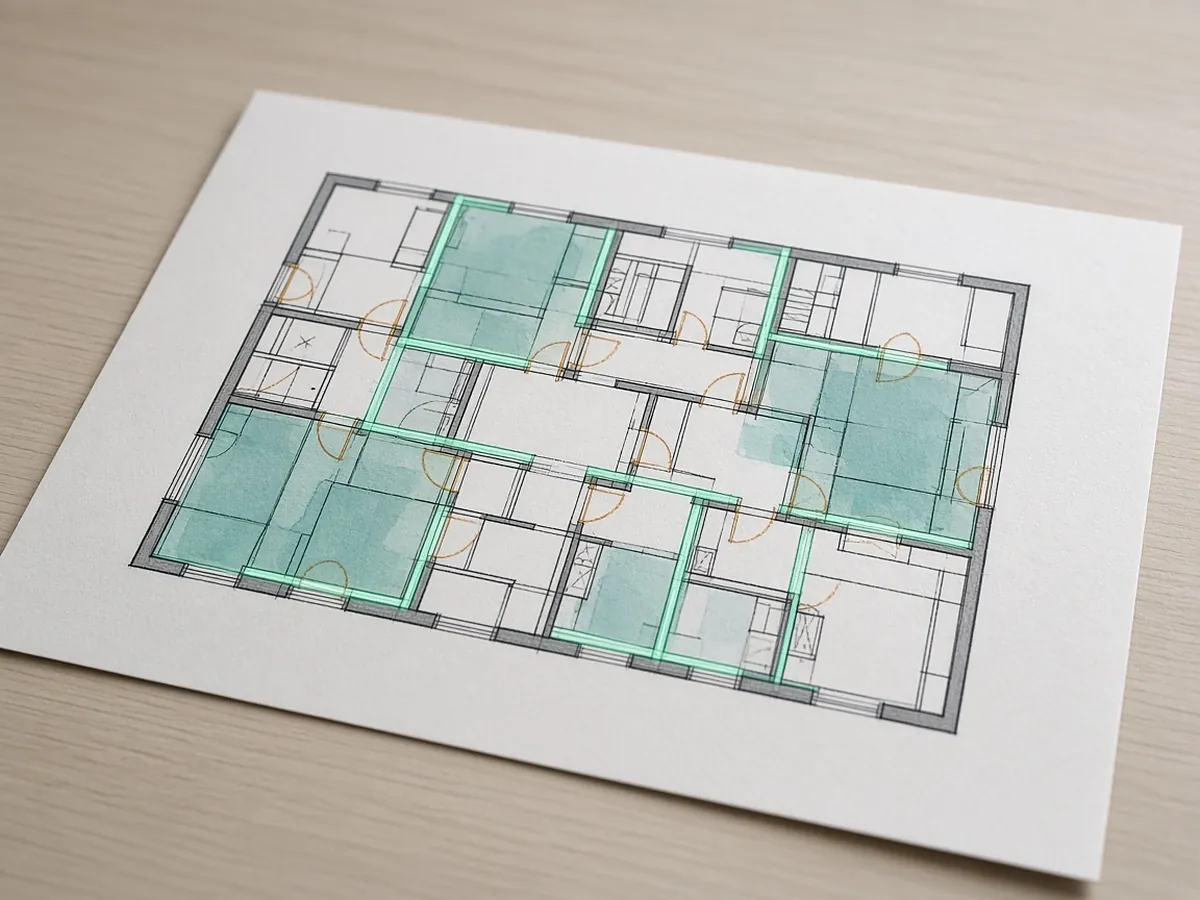
RenderDraw's part of a bid or RFP is the takeoff: AI proposes quantities from the drawings, your estimator reviews them, lowest confidence first, and approved quantities hand off to pricing and visual CPQ. Requirement tracking, the compliance matrix and the written response stay with your team.
- AI takeoff. Quantities proposed from the drawing set, with the source sheet attached.
- Estimator review. Lowest-confidence items first; nothing moves on until it is accepted.
- Pricing handoff. Approved quantities move on to pricing and visual CPQ.
- Free sample. Send one plan set and compare the result with your own takeoff.
Test one bid
Send the drawings from a recent RFP or bid. Turnaround depends on the size and quality of the set.
RenderDraw does not publish accuracy percentages or time-saved claims. Test it on your own plan set.
Questions estimators ask.
What is bid and proposal management?
Owning the bid process end to end. That covers the opportunity pipeline, go/no-go decisions, deadlines, documents, questions, content, pricing inputs, reviews, submission and debriefs.
What does a bid or proposal coordinator do?
Tracks deadlines, collects documents and forms, requests bonds and insurance certificates, formats the submission, runs checklists and confirms delivery.
What is a bid and proposal engineer?
The technical lead on engineered bids. They interpret specifications, define the technical solution and support pricing with quantities and assumptions.
What are Sections L and M in a federal RFP?
Under the FAR's uniform contract format, Section L gives the instructions to offerors (format, page limits, volumes) and Section M lists the evaluation factors for award. Build your outline from L and your win themes from M.
What happens if a federal proposal is late?
Under FAR 15.208, a proposal that reaches the designated office after the exact time is late and generally isn't considered. Narrow exceptions exist, such as an electronic submission received at the government's initial point of entry by 5:00 p.m. one working day before the due date. Plan to submit early.
Are there certifications for proposal managers?
Yes. APMP, the Association of Proposal Management Professionals, offers Foundation, Practitioner, Capture Practitioner and Professional certifications, with experience requirements that rise from about one year to seven or more.
How do I avoid late submissions?
Set internal deadlines at least a day before the official one, register on and test electronic portals early, request bonds and insurance certificates on day one, and assign one named person to submit.
Does RenderDraw support proposal management?
Not as proposal-management software. RenderDraw's part is the takeoff: AI proposes quantities with the source sheet attached, your estimator reviews them, and approved quantities hand off to pricing and visual CPQ. Get a free sample takeoff.
Keep every bid on track.
Start with the takeoff: send one plan set for a free sample and see what RenderDraw's AI proposes and flags for review.
- Pick one recent bid or RFP with drawings.
- Run the takeoff and estimator review with RenderDraw.
- Decide on next steps with real output in front of you.
Related tools and guides
Keep reading on renderdraw.com
Sources and further reading
- FAR 15.204-1 Uniform contract format (Acquisition.gov)
- FAR 15.208 Submission, modification, revision and withdrawal of proposals (Acquisition.gov)
- APMP: Signature certification program (Cert-a-thon 2026)
- APMP Practitioner OTE Preparation Guide 2026 (PDF)
- AIA Contract Documents: Instructions for A701-2018, Instructions to Bidders
Figures marked as rules of thumb are starting points, not standards. Check the current edition of any code or standard your project specifies, and use your own historical production rates where you have them. Sources checked 2026-11-01.