
How to write a construction bid proposal that gets carried.
A bid proposal is your price plus the written scope behind it. GCs compare proposals line by line on bid day, and the one that's clear, complete and easy to level often gets carried even when it isn't the lowest number. Here's how to respond to an invitation, structure the proposal, write scope that holds up, and protect yourself with validity terms.
Send one plan set. See what the AI extracts and what it flags for review. No obligation.
- From invitation to proposal
- Structure and language
- Validity and risk
- Bid-day checklist
Responding to a bid invitation
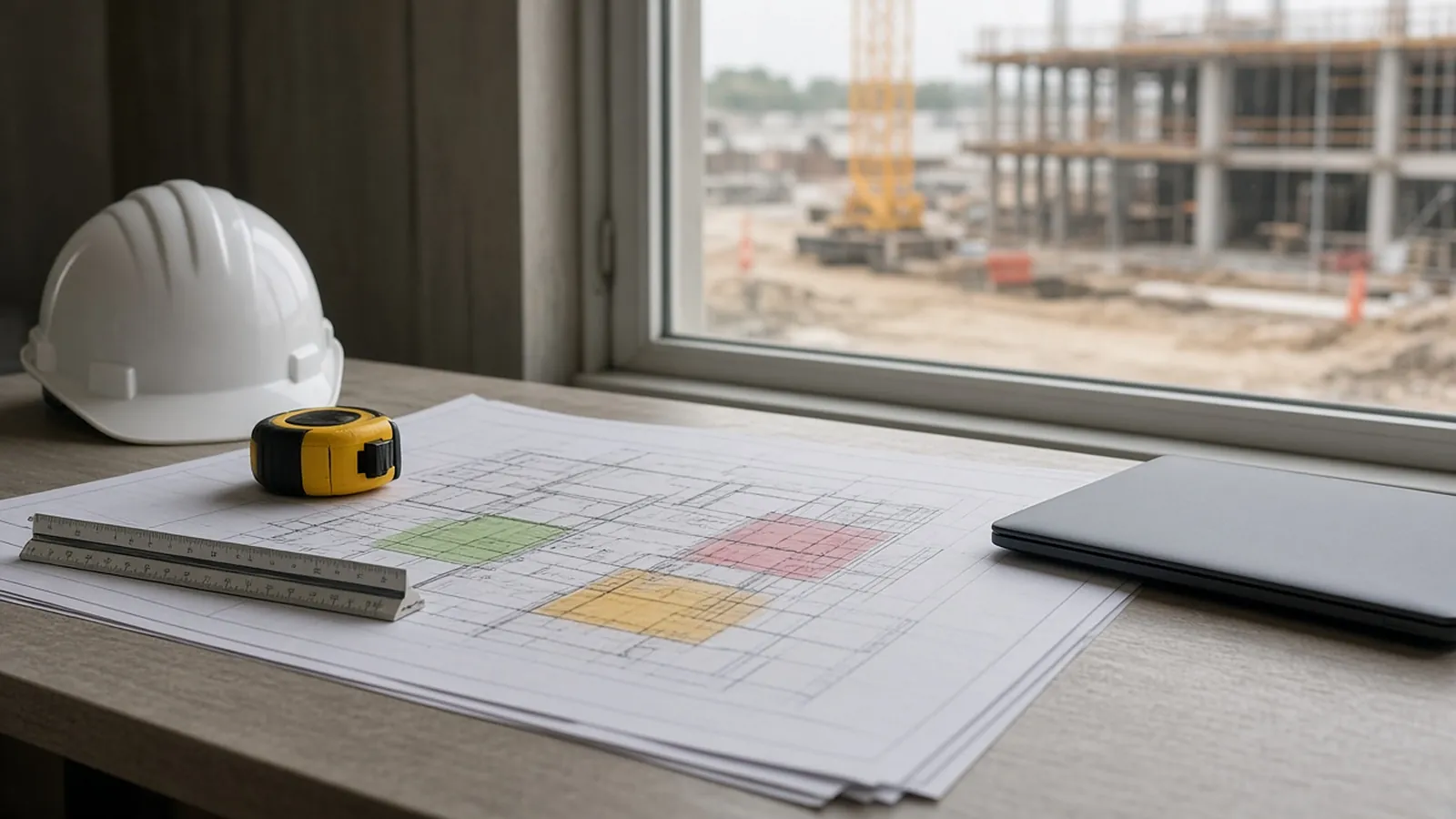
An invitation to bid (ITB) tells you the project, scope packages, bid due date and time, where to get documents, pre-bid meeting details and submission requirements. Before you commit time, check that the scope matches your trade, the schedule and location work for your crews, and you can meet the bond and insurance requirements.
- Confirm intent to bid. Many GCs track this.
- Download the full set and specs, and log sheets and dates.
- Attend the pre-bid meeting, or review its notes.
- Submit RFIs before the question deadline. Under AIA A701-2018, unless modified, that's at least 7 days before bids are due.
- Track addenda through bid day. A701 has addenda issued no later than 4 days before the bid date, but owners can change that.
What goes in a proposal
- Header: company, license, contact, date and proposal number.
- Project and recipient.
- Documents: drawing sheets and dates, spec sections, and addenda acknowledged.
- Base bid as a single lump sum.
- Alternates and unit prices, each priced and labeled.
- Scope of work by system or area.
- Inclusions that might otherwise be questioned.
- Exclusions, specific and referenced.
- Clarifications and assumptions.
- Schedule assumptions and lead times.
- Terms: validity, payment, escalation and signature.
Writing scope that holds up
Specific beats general. "Furnish and install structural steel per S-series drawings" leaves room for argument. "Furnish and install structural steel framing per S-101 through S-501 dated 05/02, including base plates and anchor bolts as scheduled; excludes metal deck and misc. metals in 05 50 00" does not. Reference sheets, details and spec sections, and use the same terms the documents use.
| Trade | Example inclusion |
|---|---|
| Electrical | Furnish and install branch circuits, devices and lighting per E-sheets; fixtures per the fixture schedule, including Types A1 to A6. |
| Painting | Paint walls, ceilings and HM frames per the finish schedule: one primer and two finish coats on new gypsum board. |
| Flooring | Furnish and install LVT, carpet tile and rubber base per the finish plan, including concrete moisture testing at the method and frequency in the spec. |
| Steel | Furnish and erect structural steel per S-sheets, including shop primer; connection design only where the documents delegate it. |
And clarifications
- Exclude by item and spec section, not by vague category.
- State conditions your price depends on: working hours, phasing, access and owner-furnished items.
- Note escalation and lead-time risks for volatile materials.
- Keep exclusions consistent with the bid form so leveling is easy.
Why your number can bind you
In Drennan v. Star Paving (Cal. 1958), a subcontractor was held to its bid because the general contractor relied on it, and many states follow that reasoning. Your supplier's quote may also be a firm offer: under UCC §2-205, a merchant's signed written offer to sell goods that says it will be held open is irrevocable for the stated time, up to three months. In practice:
- State a validity period (for example, "valid for 30 days from bid date") and what happens after it.
- Match your suppliers' quote validity to yours, or qualify the materials.
- Tie the price to the documents listed in your basis of bid.
This isn't legal advice. Have your standard terms reviewed.
A short sample proposal
To: [GC estimator], [GC] Project: [name], [city]
Scope: Interior painting, Section 09 91 23
Basis of bid: Drawings A-001-A-501 dated March 3; specification 09 91 23;
Addenda 1 and 2 acknowledged.
BASE BID: Eighty-four thousand two hundred dollars ($84,200.00)
Alternate 1 (add): Epoxy at kitchens and break rooms ......... $6,450
Unit price: Additional wall area, 1 primer + 2 finish ........ $1.85/sf
Includes: Walls, ceilings, HM frames per finish schedule; one primer and two
finish coats on new gypsum board; daily cleanup of our debris.
Excludes: Wallcovering (09 72 00); exterior coatings; patching beyond Level 4
finish; premium time.
Clarifications: One mobilization per floor; 10-week duration from start.
Valid 30 days from bid date. Payment per subcontract, net 30 from GC receipt.
All prices are invented for illustration.
Tenders
Outside North America, "tender" often replaces "bid," and tender documents may require a priced bill of quantities. The principles are the same: a specific basis, clear scope, explicit exclusions and stated conditions.
That lose bids
- Missing an addendum acknowledgment.
- Late submission or the wrong format.
- Exclusions that conflict with the bid form.
- A number without scope, so the GC can't level it.
- Typos in the base bid, or words and figures that disagree.
Bid day
- All addenda acknowledged by number on the proposal and the bid form.
- Base bid written in words and figures, and they match.
- Alternates labeled add or deduct, numbered as in the bid documents.
- Unit prices in the units requested.
- Bond, insurance and license information attached if required.
- Exclusions reviewed against the bid form so nothing conflicts.
- Proposal sent to the right contact before the deadline, with confirmation of receipt.
Follow up
Ask about results and how your number compared. That feedback improves your next bid. When you win, the proposal becomes the basis of your subcontract scope, so the clarity you put in now protects you later.
A reviewed takeoff
RenderDraw's AI takeoff proposes quantities with the source sheet on every row, for estimator review. A proposal written from a reviewed, sourced takeoff is easier to defend than one rebuilt from memory on bid day. Writing the proposal stays with you. Get a free sample takeoff.
Where RenderDraw fits: the counting, with your review.
Speed is easy to promise. Defensible numbers are the job, so RenderDraw keeps the estimator in control of every quantity that gets priced.
- Source on every row. Each quantity keeps its source sheet, location and reviewer decision.
- Lowest confidence first. The review queue shows the drawing tile with the detection highlighted and the extracted value.
- Uncertain items flagged, not hidden. Anything the AI can't confirm goes to the estimator rather than being guessed.
- Nothing priced before approval. Rows move on to pricing only after they are accepted.
Questions estimators ask.
How do you write a construction bid proposal?
List the documents, base bid, alternates and unit prices, scope, inclusions, exclusions, clarifications, schedule and terms, all tied to your takeoff.
How long should my bid be valid?
State a period, commonly 30 to 90 days, and match it to your suppliers' quote validity. A GC that relied on your bid may be able to hold you to it.
What is a bid proposal invitation?
An invitation from an owner or GC to submit a bid, with documents, due dates and requirements.
Should I include a cost breakdown?
Only if requested. Otherwise give a clear base bid, with alternates and unit prices separated.
What is a construction tender?
The common term for a bid in many countries, sometimes with a priced bill of quantities.
Where can I find a construction bid proposal example?
This page includes a sample proposal plus example basis-of-bid, inclusion, qualification, alternate and unit-price language.
See what the AI reads on your own drawings.
Send one representative trade plan set. RenderDraw reviews it and follows up with what the AI extracted and what it flagged for review. Your files remain private while the request is assessed, and there is no obligation.
- Upload the plan set, legends and schedules, the spec sections for your scope and any addenda.
- RenderDraw reviews the set and the scope you want tested.
- We follow up with extracted quantities, flagged items and next steps.
Where these numbers come from
We checked this guide against the standards, manufacturer documents and industry references below (last reviewed November 2026). Figures marked as rules of thumb are typical ranges, not requirements; your project documents, local code and your own cost history govern.